
Thread Hacking and Cyberwarfare / Original thread
More About MORE: Worm Research, Code Red, and Nimda
Original posts. Original order. Sources and media stay with them.
October 1, 20268posts15source URLs7archived media items
MORE ABOUT MORE
🧵THREAD🧵(1/6)
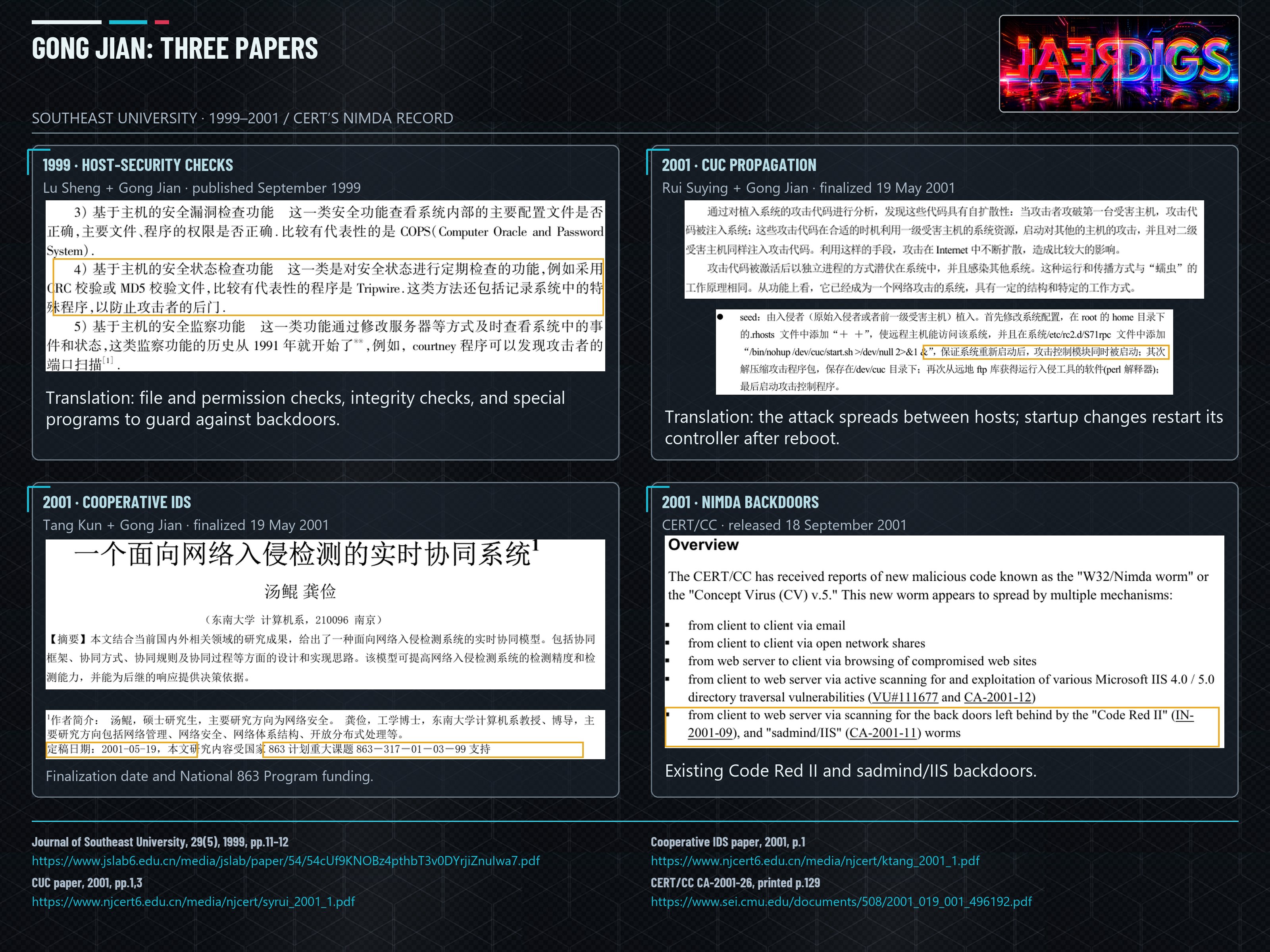
Southeast University’s Gong Jian coauthored research on backdoor detection and distributed security management in 1999. [1]
On May 19, 2001, two more papers bearing his name were finalized: an analysis of CUC’s self-propagation and reboot persistence, and an 863-funded cooperative intrusion-detection system. [2][3]
By September, CERT documented Nimda exploiting backdoors left by Code Red II and sadmind/IIS. [4]
One researcher connects the academic papers; CERT records how successive worms reused compromised access. [1][2][3][4]
https://x.com/MusktardNCatsup/status/2105014815043604818?s=20
(2/6)
Tsinghua’s DIDAPPER paper, submitted in September 1999 and published in 2001, went beyond diagramming worm spread. [5]
Its authors built a simple test worm that copied itself between hosts using known passwords, and reported detecting it even when propagation slowed to once every 30 minutes. [5]
The 863-funded system combined IP traps, shared traffic samples and neural-network analysis. [5]
In July 2001, Code Red’s automated scanning and host-to-host spread brought those detection problems to internet scale. [4]
(3/6)
In 1997, UESTC researchers Liu Naiqi and Zuo Zhihong described infecting legitimate diagnostic tools, utilities and antivirus programs so normal use would introduce and spread malicious code. [6]
Their paper explicitly framed this as virus warfare. [6]
In September 2001, CERT documented Nimda creating Trojan versions of legitimate applications: they ran the worm first, then performed their intended function. [4]
The precise overlap: ordinary software execution becoming a vehicle for concealed infection and propagation. [6][4]
(4/6)
At Nanjing University, a paper submitted in November 2000 examined mobile programs that move between networked hosts and execute there. [7]
Its threat model described agents exploiting vulnerabilities to gain privileges—and quietly disrupting a network while obeying individual hosts’ security rules. [7]
The team implemented safeguards in Mogent 2.0. [7] In 2002, Jonathan Choi funded a separate software R&D centre at the same university. [8]
Mobile-code research and the Sun Wah partnership overlap institutionally. [7][8]
(5/6)
On July 12, 2001—the date CAIDA records Code Red I’s first variant beginning to spread—a journal received HKUST researchers Dit-Yan Yeung and Yuxin Ding’s intrusion-detection paper. [9][10]
Their tests included backdoored Unix programs. [10] Some compromised-program traces were identical to normal ones and went undetected. [10]
The authors noted that altered programs can produce normal traces when a run never executes the malicious code. [10]
The research and outbreak share the same recorded date; publication followed in 2003. [9][10]
(6/6)
In 1998, MSU professor Lionel Ni’s CC&T joined Sanjiang—the M-11 missile developer—to establish 3JET in Zhuhai, commercializing Internet telephony. [11][12][13]
In October 2000, Jonathan Choi’s Sun Wah launched a Linux server with Red Flag Software of the Chinese Academy of Sciences. [14]
HKUST approached Ni in late 2001; he became its computer-science professor and department head in July 2002. [15][11]
The connections ran through companies, commercial systems and university appointments. [11][13][14][15]
READ THE FULL REPORT AND SUPPORT THE WORK AT http://GUSQUIXOTE.COM!!!
Sources:
[1] https://www.jslab6.edu.cn/media/jslab/paper/54/54cUf9KNOBz4pthbT3v0DYrjiZnuIwa7.pdf
[2] https://www.njcert6.edu.cn/media/njcert/syrui_2001_1.pdf
[3] https://www.njcert6.edu.cn/media/njcert/ktang_2001_1.pdf
[4] https://www.sei.cmu.edu/documents/508/2001_019_001_496192.pdf
[5] https://web.archive.org/web/20070315003517/https://www.jos.org.cn/1000-9825/12/225.pdf
[6] https://www.juestc.uestc.edu.cn/cn/article/pdf/preview/3826.pdf
[7] https://www.jos.org.cn/1000-9825/13/1991.pdf
[8] https://sbc.nju.edu.cn/jb/sysyl/dzkxygcxy/20140606/i2060.html
[9] https://www.caida.org/catalog/papers/2002_codered/codered.pdf
[10] https://www2.cs.uh.edu/~acl/cs6397/Presentation/2003-ELsevier-host-based%20id%20using%20dynamic%20and%20static%20behavioral%20models.pdf
[11] https://cse.hkust.edu.hk/pg/seminars/F04/ni.html
[12] https://nuke.fas.org/guide/china/contractor/ssg.htm
[13] https://web.archive.org/web/19990829153134/http://www.3jet.com/news7.htm
[14] https://lwn.net/2000/1026/a/redflag.php3
[15] https://davidmhsu.substack.com/p/the-american-dream-off-to-college
15source links
- https://www.jslab6.edu.cn/media/jslab/paper/54/54cUf9KNOBz4pthbT3v0DYrjiZnuIwa7.pdf
- https://www.njcert6.edu.cn/media/njcert/syrui_2001_1.pdf
- https://www.njcert6.edu.cn/media/njcert/ktang_2001_1.pdf
- https://www.sei.cmu.edu/documents/508/2001_019_001_496192.pdf
- https://web.archive.org/web/20070315003517/https://www.jos.org.cn/1000-9825/12/225.pdf
- https://www.juestc.uestc.edu.cn/cn/article/pdf/preview/3826.pdf
- https://www.jos.org.cn/1000-9825/13/1991.pdf
- https://sbc.nju.edu.cn/jb/sysyl/dzkxygcxy/20140606/i2060.html
- https://www.caida.org/catalog/papers/2002_codered/codered.pdf
- https://www2.cs.uh.edu/~acl/cs6397/Presentation/2003-ELsevier-host-based%20id%20using%20dynamic%20and%20static%20behavioral%20models.pdf
- https://cse.hkust.edu.hk/pg/seminars/F04/ni.html
- https://nuke.fas.org/guide/china/contractor/ssg.htm
- https://web.archive.org/web/19990829153134/http://www.3jet.com/news7.htm
- https://lwn.net/2000/1026/a/redflag.php3
- https://davidmhsu.substack.com/p/the-american-dream-off-to-college
lol...I don't have speakers anymore but my earbuds tell me that is frighteningly loud 🤣😂